
ECI SIR: 3 Key Claims in Court
New Delhi, October 27, 2026: The Election Commission of India (ECI) has defended its Special Intensive Revision (SIR) of electoral rolls before the Supreme Court. In an affidavit filed on October 26, the Commission said that three orders related to the SIR exercise were approved unanimously by its three members.
The ECI SIR: 3 Key Claims in Court focus on the approval of SIR orders, the status of Form 6 and the Commission’s internal decision-making process. The ECI rejected allegations that the Chief Election Commissioner took these decisions without the approval of the other two Election Commissioners.
This ECI SIR: 3 Key Claims in Court report explains the Commission’s position, the main legal questions and what the dispute could mean for electoral roll revision. The statements in the affidavit represent the ECI’s position and should not be treated as final judicial findings.
ECI SIR: 3 Key Claims in Court Explained
The affidavit highlights three central issues in the legal dispute. These are the approval of SIR orders, the use of Form 6 and the Commission’s internal decision-making procedures.
| Key issue | ECI’s position |
|---|---|
| 1. SIR orders | The Commission said all three orders were approved unanimously. |
| 2. Form 6 | The ECI maintained that the statutory form was not amended. |
| 3. Decision-making | The Commission explained how members’ observations and approvals are handled. |
These three issues form the central points of the ECI SIR: 3 Key Claims in Court. The Supreme Court will consider the legal questions raised by the parties during the proceedings.
1. ECI Says All Three SIR Orders Were Unanimous
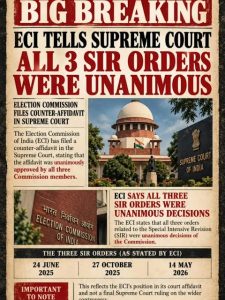
The Election Commission told the Supreme Court that three SIR orders issued on June 24, 2025, October 27, 2025, and May 14, 2026, were approved unanimously.
The Commission comprises Chief Election Commissioner Gyanesh Kumar and Election Commissioners Sukhbir Singh Sandhu and Vivek Joshi. The ECI denied allegations that the Chief Election Commissioner independently issued the disputed directions without the concurrence of the other members.
According to the affidavit, the orders were issued following decisions of the full Commission. The ECI defended its administrative procedures and challenged allegations concerning its functioning.
The ECI SIR: 3 Key Claims in Court dispute also involves questions about internal communications and the participation of individual members. The court will consider the submissions and relevant material presented by the parties.
2. ECI SIR: 3 Key Claims in Court on Form 6
Form 6 is the prescribed application used by eligible citizens to apply for inclusion in electoral rolls. The form has become a significant issue in the dispute over the SIR exercise.
The ECI maintained that it did not amend the statutory Form 6 through its SIR orders. It said the additional declaration associated with the revision process was a separate document rather than an amendment to the prescribed form.
The Commission explained that the declaration appeared alongside the online application to allow applicants to complete the process using a one-time password and electronic signature.
The ECI acknowledged that the way the declaration was displayed online could create the impression that Form 6 had been changed. It said the online application process was separated into Form 6 and a separate declaration from October 21, 2026.
This distinction is important because the Commission maintains that changes to the statutory form fall within the authority of the Central Government under the applicable rules.
One of the main questions discussed in ECI SIR: 3 Key Claims in Court is whether the additional declaration should be understood as a separate administrative document or as a change to the prescribed application process.
3. How Does the Commission Make Decisions?
The affidavit also addressed questions about internal notes, suggestions and observations recorded while official files are processed.
The ECI said that observations made by individual commissioners or officials during the decision-making process do not automatically constitute final decisions of the Commission.
It explained that files ordinarily pass through the Election Commissioners before reaching the Chief Election Commissioner. In urgent cases, approvals may be obtained electronically and subsequently recorded in official files.
The Commission rejected the allegation that the disputed SIR orders were unilateral decisions. The legal challenge also concerns questions about internal communications and administrative functioning.
In its response, the ECI defended the procedures followed for approving the orders. The court’s assessment of the legal arguments will be important in determining how these issues are addressed.
Why Is ECI SIR: 3 Key Claims in Court Important for Voter’s?
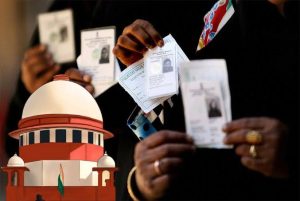
The Special Intensive Revision is an exercise involving the revision of electoral rolls. Accurate voter lists are important because they help determine whether eligible citizens are registered to participate in elections.
The ECI SIR: 3 Key Claims in Court matter has drawn attention to voter registration rules, the use of additional declarations and the procedures followed when the Election Commission makes administrative decisions.
For citizens, the issue highlights the importance of checking registration details and following official instructions issued by the relevant electoral registration authorities.
Voters should rely on official notifications when checking application requirements. News reports and online discussions should not be treated as substitutes for applicable rules or official guidance.
Readers seeking further information can visit the official Election Commission of India website for electoral roll and voter registration resources.
What Happens Next in the Supreme Court?
The Supreme Court is examining petitions concerning the Election Commission’s functioning and decisions related to the SIR exercise.
The Commission’s affidavit places its explanation before the court, but filing a response does not itself settle the dispute. The court will consider the legal arguments and relevant material presented by the parties.
Further developments will depend on the submissions made by the parties and the directions issued by the Supreme Court. Readers can follow court-related updates through the Supreme Court of India website.
ECI SIR: 3 Key Claims in Court — Official Resources
The following official resources provide background information about election administration, legislation and judicial proceedings.
- Election Commission of India — Official Website
- Voters’ Services Portal — Registration Services
- Supreme Court of India — Official Website
- Legislative Department — Government of India
- India Code — Central Laws and Legislation
External News Reports on the SIR Case
- LiveLaw — ECI’s Position on SIR Orders and Form 6
- Bar and Bench — ECI Affidavit and Supreme Court Case
- India Today — Form 6 and Online SIR Declaration
- The Indian Express — ECI’s Affidavit on SIR
- DD News — ECI’s Statement on SIR Orders
- The New Indian Express — ECI’s Response Before the Court
Related News on DeshPrism
Readers can explore more national and regional reports through these related DeshPrism articles.
- PM Modi Exposes 3 India Threats
- UNESCO Adds 3 Indian Sites: Major Win
- Kashi Tamil Sangamam 5.0: 3 Big Updates
- Odisha Police Recruitment 2026
- India’s Economic Outlook
- Trump’s 100% Tariff on India
- Odisha Janasunani: Key Updates
- India vs NZ 2026: Big T20I Battle
Conclusion: ECI SIR: 3 Key Claims in Court
The ECI SIR: 3 Key Claims in Court centre on the Commission’s defence of its SIR orders, its position on Form 6 and its internal decision-making process.
The Election Commission maintains that the three orders were approved unanimously and that the prescribed Form 6 was not amended. Petitioners have raised questions about the Commission’s functioning and the handling of voter registration.
The legal dispute remains subject to judicial consideration. The Supreme Court’s proceedings will determine how the questions raised by the parties are addressed.
Disclaimer: This article summarises reported developments as of October 27, 2026. The Commission’s statements are attributed to the ECI, and allegations are not presented as established judicial findings.